
Views: 0 Author: Site Editor Publish Time: 2026-09-29 Origin: Site


Transitioning from traditional 2D paper fresheners to canned formats unlocks massive growth opportunities. Upgrading to rigid containers allows brands to command higher retail price points while substantially extending product lifespan on the shelf. The automotive accessory market increasingly demands these premium sensory experiences. However, selecting the right packaging involves navigating significant friction points. You must constantly balance unit economics against shelf appeal, material compatibility against complex fragrance compounds, and strict regulatory compliance. A single misstep in material selection can lead to costly leaks or ruined scent profiles. This guide provides a comprehensive framework for evaluating different packaging materials, advanced printing methods, and potential manufacturing partners. You will learn how to mitigate risks during the critical prototyping phase. Ultimately, we aim to help you successfully launch a durable, high-margin premium product line.
Material choice (tinplate vs. aluminum) dictates product durability, weight, and compatibility with specific fragrance bases (gel, fiber, or organic blocks).
Printing methodology should align with order volumes; high-volume orders benefit from direct lithography, while lower MOQs require labeling or shrink sleeves.
Compliance is non-negotiable: Reliable packaging must prevent leakage, withstand temperature fluctuations in automotive environments, and meet local VOC regulations.
Evaluating a manufacturing partner requires looking beyond unit price to assess prototyping speed, QA processes, and supply chain transparency.
Modern consumers expect more than just a pleasant scent from air fresheners. They demand a complete sensory experience. Canned formats deliver exactly this upgrade.
Rigid packaging instantly elevates perceived value. Consumers easily recognize metal tins as premium items. They gladly pay higher retail prices for them compared to disposable paper alternatives. You can effectively target upscale automotive boutiques and premium home retail sectors. A well-designed private label car air freshener positioned in a sleek can easily commands double or triple the margin of basic hanging cardboard formats.
Exposed formats lose their fragrance rapidly. Airflow constantly strips away delicate top notes. In contrast, canned environments provide a completely sealed sanctuary. They rigorously protect volatile organic compounds (VOCs) before the consumer activates them. This sealed environment extends shelf life dramatically. Once opened, adjustable lids allow users to control the diffusion rate. This intentional pacing ensures the fragrance lasts for months rather than mere days.
You must clearly define what makes packaging successful for your specific brand. Without measurable criteria, production decisions become arbitrary.
Target cost-per-unit: Determine your absolute ceiling for manufacturing costs to protect wholesale margins.
Unboxing experience: Evaluate how the closure mechanism feels and sounds when opened.
Retail footprint: Consider how the can stacks or displays on standard retail shelving.
Durability: Verify the container can survive international shipping without denting.
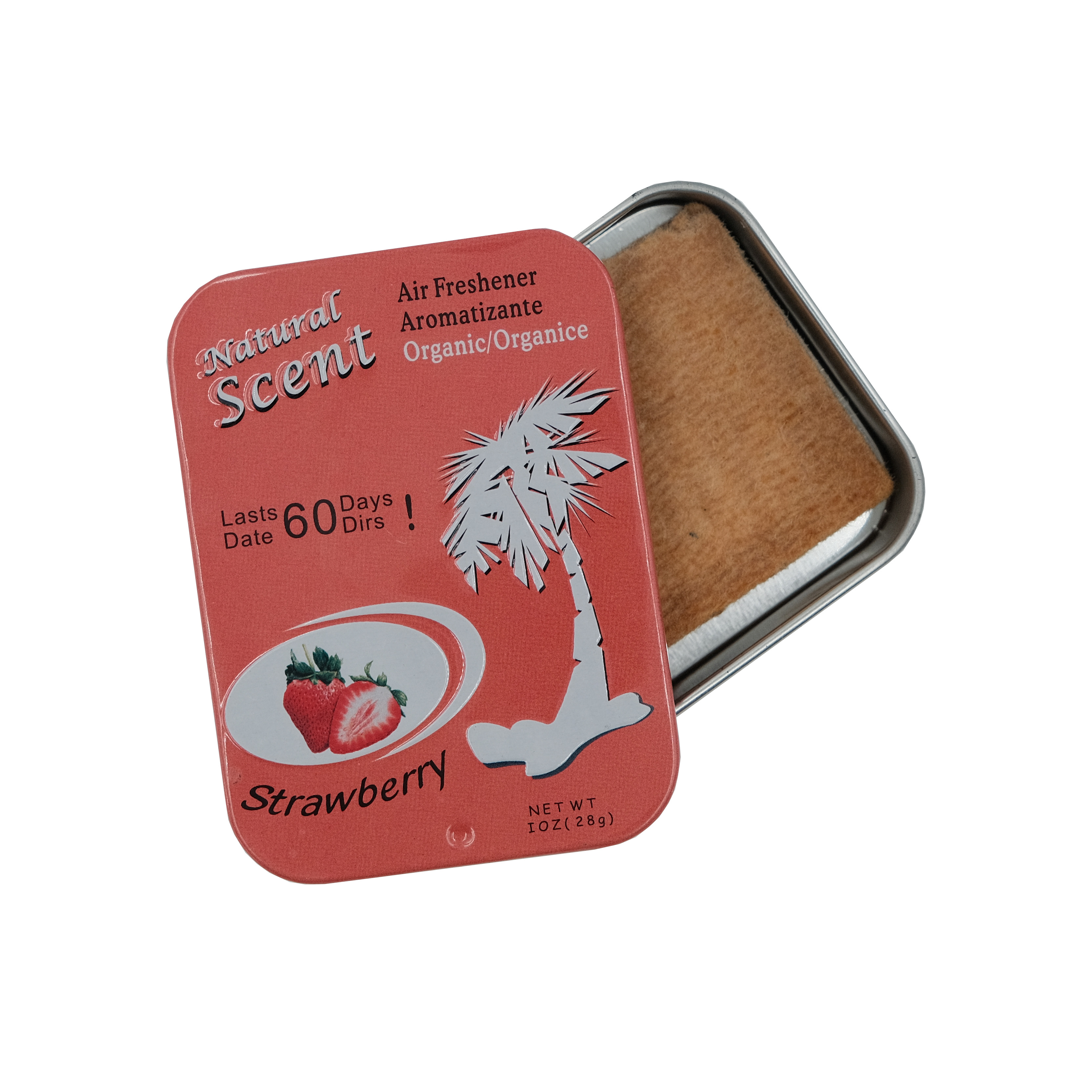
Choosing the correct base material forms the foundation of reliable custom air freshener packaging. Your selection directly impacts shipping weight, product lifespan, and aesthetic appeal.
Manufacturers primarily construct these products from either tinplate or aluminum. Each metal serves distinct business needs and fragrance types.
Tinplate vs. Aluminum Packaging Comparison
Material Feature | Tinplate Cans | Aluminum Cans |
|---|---|---|
Cost Profile | Highly cost-effective | Higher unit cost |
Structural Rigidity | Very rigid, resists crushing | Lightweight, prone to minor dents |
Corrosion Resistance | Requires internal protective coating | Naturally corrosion-resistant |
Best Application | Solid blocks, fiber pads | Moisture-heavy gels, premium lines |
Tinplate remains highly popular due to its cost efficiency. However, it requires robust internal protective coatings. Without these coatings, moisture-heavy fragrance gels will quickly induce rust. Aluminum provides a lighter footprint and natural rust resistance. It serves perfectly for high-end retail collections where perfection is mandatory.
The lid acts as the primary user interface. It requires meticulous engineering to ensure a satisfying consumer experience.
Vented plastic lids: These require smooth, adjustable diffusion controls. Test the rotation mechanism repeatedly. It should glide easily but hold its position securely. Consumers strongly dislike stiff or easily broken vents.
Ring-pull metal seals: These internal closures ensure vital tamper evidence. They completely lock in the scent profile during global transit. The pull ring must detach cleanly without leaving dangerous sharp edges.
Material incompatibility creates severe financial risks. Certain aggressive essential oils, particularly citrus and cinnamon, can dissolve standard interior can coatings. This reaction leads to rapid discoloration of the scent medium. It can fundamentally alter the desired scent profile. In extreme cases, it causes catastrophic structural degradation. Always demand rigorous chemical compatibility testing before authorizing full-scale production.
Your branding application method must align seamlessly with your operational scale. Different printing techniques offer varying levels of durability and visual impact for your custom can air freshener.
This process prints ink directly onto the metal surface before the factory forms the can.
Best for: High-volume, continuous production runs.
Outcome: It delivers a supremely premium finish. The artwork becomes inherently scuff-resistant. You achieve seamless branding wrapping around the entire container.
Constraint: Factories demand massive setup costs for lithography. They also enforce extremely rigid minimum order quantities (MOQs). This makes it unsuitable for rapid seasonal testing.
Factories slide a printed polymer tube over the can and apply heat to shrink it tight.
Best for: Complex, 360-degree full-color designs on contoured cans.
Outcome: You gain high visual impact and excellent moisture resistance. It allows for brilliant photographic designs.
Risk: The artwork faces a high potential for design distortion. As the sleeve shrinks, logos and text can warp. You must properly template the artwork using specialized 3D distortion software.
Automated machines wrap pre-printed sticker labels around bare cans.
Best for: Rapid market testing, low MOQs, and varied scent SKUs.
Outcome: It supports highly agile inventory management. You can buy blank cans in bulk and label them as demand dictates.
Risk: Cheap materials destroy perceived value. If you use standard paper labels, they will quickly peel. Car dashboards experience intense heat and UV exposure. You must specify high-tack adhesives and UV-resistant laminates.
Creating a compliant product protects your brand from costly recalls. When developing an OEM can air freshener, integrity must drive every engineering decision.
You must carefully match the outer packaging to the internal carrier medium. Organic wood blocks behave differently than scented gels or fiber pads. Gels expand and contract with temperature swings, requiring slight extra headspace inside the can. Wood blocks release oils slowly and require specialized barrier coatings to prevent the oil from seeping into the tinplate seams. Fiber pads are lightweight but need precise internal sizing so they do not rattle unpleasantly when consumers shake the can.
Automotive environments present extreme physical challenges. A car parked in summer sunlight easily reaches interior temperatures exceeding 150°F (65°C). In winter, temperatures plunge below freezing. Packaging must maintain absolute structural integrity through these seasonal extremes. Poorly engineered plastic lids will warp under summer heat. Weak metal seams will burst as gel bases expand. You must test your packaging under accelerated thermal cycling.
Ignorance of local regulations invites severe penalties. You must verify compliance before importing or retailing any fragrance product.
VOC Compliance: Ensure the final formulation meets Volatile Organic Compound limits for your target markets. For instance, California's CARB regulations enforce strict caps on aerosolized chemicals.
MSDS Accessibility: You must secure Material Safety Data Sheets from your manufacturer. Retailers require these documents before stocking your items. They provide essential protocols for handling accidental ingestion or eye contact.
Child Safety: While not universally mandated, consider how easily a toddler can remove the plastic lid. Adding slight resistance to the vent closure improves overall safety.
Your manufacturing partner ultimately dictates your product quality. Selecting the right vendor for a Private Label Can Air Freshener requires moving beyond simple unit pricing.
Distinguish carefully between Original Equipment Manufacturers (OEM) and Original Design Manufacturers (ODM). An OEM factory typically prints your artwork onto their existing, pre-engineered stock cans. This route guarantees speed and reliability. Conversely, an ODM partner possesses deep engineering capabilities. They can help you design custom can shapes, invent proprietary lid mechanics, and formulate exclusive scent profiles. Choose an ODM if you need genuine structural differentiation.
Never overextend your initial capital. Structure your product rollout by matching vendor minimums with your inventory risk tolerance. Ask potential partners about their tier pricing. A factory might require 10,000 units for lithography but only 2,000 units for adhesive labeling. Understand how their pricing scales as your volumes grow. Ensure they have the production capacity to handle sudden viral success without sacrificing quality assurance.
Never sign a mass production contract based on digital renderings alone. Implement a strict physical testing phase.
Request unbranded samples: Ask for blank physical units. Test the lid mechanics repeatedly. Feel the material heft in your hand.
Conduct extreme temperature tests: Place the sample units in an industrial oven at 150°F for 48 hours. Afterward, check for seal integrity. Verify the plastic vent has not warped.
Assess print durability: Perform tape tests on printed samples to ensure the ink adheres properly to the metal surface.
Once you vet the samples, formalize your requirements. Draft a comprehensive Request for Quote (RFQ). A professional RFQ eliminates costly misunderstandings. Include your specific desired materials (e.g., aluminum base, vented plastic lid). Specify your chosen printing method. Detail your projected annual order volumes. Finally, demand copies of all required facility certifications, such as ISO 9001 and REACH compliance.
Launching a premium canned air freshener line requires a disciplined evaluation framework. You must carefully align your base material choices, branding methods, and manufacturing partner capabilities with your target profit margins. Remember that tinplate offers scale and affordability, while aluminum provides undeniable premium appeal and rust resistance. Always prioritize core functionality alongside aesthetics. A beautiful can that leaks or warps in a hot car will instantly destroy brand trust and eliminate repeat purchases. Take immediate action today to validate your initial specifications. Request a blank sample kit from a shortlisted factory, or initiate a consultation with a packaging engineer to review your chemical compatibility requirements.
A: For direct-to-metal lithography, standard MOQs typically range between 10,000 and 20,000 units per design. If you need lower minimums, factories can often produce 1,000 to 3,000 units by utilizing adhesive labels or shrink sleeves on stock blank cans.
A: Yes. Aluminum is highly recyclable and often preferred by eco-conscious brands. Additionally, you can specify biodegradable carrier mediums inside the can, such as compressed organic wood blocks or natural plant fibers, instead of synthetic polymer gels.
A: When manufactured with a robust ring-pull metal seal, an unopened can air freshener generally retains its full fragrance integrity for 18 to 24 months. Proper warehouse storage away from extreme heat ensures maximum shelf life.
A: Yes. Automotive lids require tightly clicking, adjustable vents to regulate scent release in small, hot cabins. Home-use lids often feature wider, static grilles designed for maximum immediate fragrance throw in larger, temperature-controlled rooms.


